World Taekwondo Mandeville Kup Grading & Technical Guidance Syllabus  ·  5th Kup — Blue Stripe  ·  Revised Edition 2026
World Taekwondo Mandeville · Mandeville, Jamaica

5th Kup
Blue Stripe

Kup Grading & Technical Guidance Syllabus. Taegeuk O-Jang — trigram Seon ☴, the wind: gentle, and capable of destroying everything in its path.

Opens your print dialogue — choose Save as PDF as the destination.
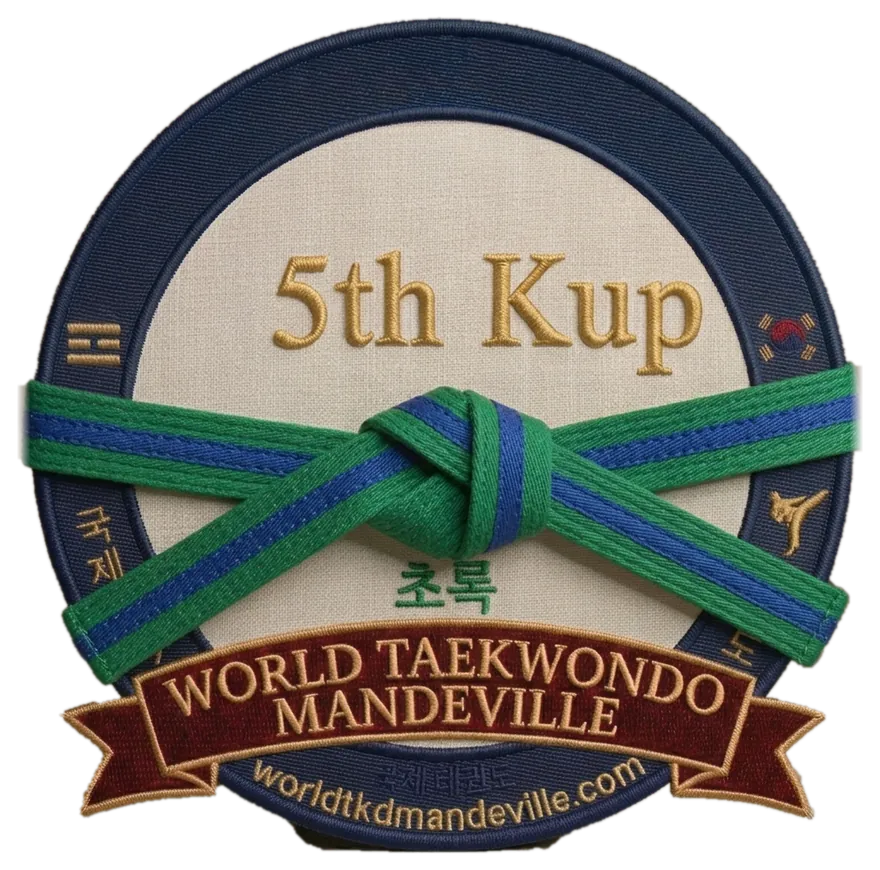
Blue Stripe rank patch — World Taekwondo Mandeville
→

01 — The rankWhat this grade asks of you

At beginner level, sparring is a matter of remembering which technique to throw and getting the blocks you know in the way. This is the rank where that stops being good enough: the theory here is distance, and blocking a kick with the arms becomes the last resort rather than the plan.

Syllabus poomsaeTaegeuk O-Jang — 20 movements, trigram Seon ☴
Time in grade4 months · 30–35 classes, minimum two sessions per week
Grading to4th Kup — Blue Belt
New at this rankHammer fist strike · turning and target elbow strikes in a form · kicking attacks in one-step sparring · two boards by hand
Belt meaningBlue signifies the heaven towards which the plant matures into a towering tree as training progresses
Eligibility

Minimums are not entitlements. Meeting them makes you eligible to be considered. Instructor recommendation is required in every case.

Theory — managing distance

At this level you should be able to move your hands swiftly to the right place to protect your body — but managing the distance matters more. Blocking a kick with the arms is a last resort. The better option is simply not to be there.

So the key theory here is distance: gaining ground quickly to score, then retracting to avoid the kick coming back. Ideally you retract far enough to make the attacker miss, with your arms covering where the kick might land — without offering the arm forward to be kicked. There is no need to take a kick on the arm if you don't have to.

History — the nine original kwans

KwanMeaning
Chung Do KwanBlue waves school
JidokwanSchool of wisdom
ChangmookwanDeveloping martial arts school
Song Moo KwanEver youthful martial arts school
MoodukkwanSchool of martial virtue
Oh Do KwanSchool of my way — General Choi's kwan
Kang Duk WonSplinter school of Changmookwan
Han Moo KwanSplinter school of Jidokwan
Jung Do KwanSplinter school of Chung Do Kwan
What the panel is looking for

The new form has a clear passage where you come towards the examiner with a block to the middle section and then a strike to the face — it should be obvious that those two are at different levels. There are also movements where two strikes happen in different directions at once: a side kick to the side and a hammer fist that effectively strikes perpendicular to it.

In one-step sparring you should at least demonstrate the principle of going backward or slipping, even if the counter-attacks come slowly or the striking surface is not yet right.

02 — KibonHand & combination techniques

Four combinations, five repetitions each, both sides, plus basics on call at the instructor's discretion.

How to read the sides

Every sequence is written left-lead — left foot forward — and is mirrored on command. Stances are named by the forward foot. The lead hand blocks and the rear hand strikes unless a step says otherwise.

Practise LEFT-LEAD
Combination 1From Left forward stance Ap KubiForward into back
  1. Left low block Arae Makki
  2. Right back-leg front kick Ap Chagi
  3. Land into right back stance Dwit Kubi → right outer-forearm middle block Momtong Bakkat Makki

Landing a kick into a back stance means landing onto the rear leg. Graded on whether the candidate lands short — landing long forces a step and loses the stance.

Combination 2From Left forward stance Ap KubiBoth directions
  1. Left palm-heel block Batangson Makki, moving back
  2. Right reverse punch Bandae Jireugi
  3. Repeat the same pair moving forward

The same technique travelling in opposite directions. Step 3 is the graded element — the mechanic must not change when the direction does.

Combination 3From Left forward stance Ap KubiTwisting block
  1. Twisting reverse single knife hand block — the rear hand blocking across the body
  2. Right back-leg turning kick Dollyo Chagi
  3. Finish in fighting stance Gyeorugi Junbi

The block puts the hips in the wrong place for the kick, deliberately. Scored on whether the candidate can still kick off the back leg without resetting.

Combination 4From Left forward stance Ap KubiFour beats
  1. Left high outer-forearm middle block Momtong Bakkat Makki
  2. Right reverse punch Bandae Jireugi
  3. Right front kick Ap Chagi
  4. Right reverse punch Bandae Jireugi on landing

Four beats without a reset. The rhythm is even — candidates lose marks by rushing beats 2 and 3 and then pausing before 4.

Safety overlay

Face-line strikes are indicated and stopped. Under-13 candidates substitute a Momtong Bandae Jireugi for any elbow, knee or face-line element and lose no marks for it. The throat, neck, temple, eyes and spine are never contacted, at any speed, at any rank.

03 — ChagiKicking & footwork

All from fighting stance, moving forward, resetting to the starting position after each set. Five repetitions each.

  • All basic to intermediate kicks, moving forward in fighting stance
  • Combination kicking — skipping axe kick, inside crescent kick and spinning hook kick
  • Consecutive kicking — front leg twist kick, roundhouse kick and cut kick
  • Jumping — side, roundhouse, hook and axe kick
  • Directional kick — name the direction and the kicks
  • Also at the instructor's discretion
Terminology

Bandal Chagi is a half-moon kick — a 45° roundhouse to the mid-section. It is not a crescent kick. The crescent kicks are An Chagi (inward) and Bakkat Chagi (outward). You are examined on the distinction from here up.

04 — PoomsaeTaegeuk O-Jang

Syllabus formTaegeuk O-Jang — required with accuracy
Movements20
TrigramSeon ☴ — the wind
CharacterLike the wind, the techniques change from quick and fast to heavier and more powerful. Gentle force that can sometimes be furious
IntroducesHammer fist strike · turning elbow strike · target elbow strike · rear cross stance finish
Also examinedKibon Il-Jang through Taegeuk O-Jang, called without warning

Watch it performed

Taegeuk O-Jang · official reference performance · Open on YouTube ↗
  1. Turn 90° left, moving the left leg into front stance — left hand low block
  2. Pull the left leg inward into left side stance — Mejumeok Naeryeo Chigi (hammer fist strike)
  3. Turn to the other side, moving the right leg into front stance — right hand low block
  4. Pull the right leg inward into right side stance — hammer fist strike
  5. Step forward with the left leg into front stance — left hand middle block
  6. In this position — right hand middle block
  7. Right leg front kick forward
  8. Land the left leg into front stance — right hand back knuckle forward strike
  9. Follow with a left hand middle block
  10. Left leg front kick forward
  11. Land the right leg into front stance — left hand back knuckle forward strike
  12. Follow with a right hand middle block
  13. Step forward with the right leg into front stance — right hand back knuckle forward strike
  14. Turn 270° left, moving the left leg into back stance — single knife hand outward block
  15. Step forward with the right leg into front stance — Palkup Dollyeo Chigi (turning elbow strike)
  16. Turn to the other side, moving the right leg into back stance — single knife hand outward block with the right hand
  17. Step forward with the left leg into front stance — turning elbow strike
  18. Turn 90° left, moving the left leg into front stance — left hand low block
  19. Follow with a right hand middle block
  20. Right leg front kick forward
  21. Land the right leg into front stance — right hand low block
  22. In this position — left hand middle block
  23. Turn 90° left, moving the left leg into front stance — left hand high block
  24. Right leg side kick forward
  25. Land forward into front stance — left arm Palkup Pyojeok Chigi (target elbow strike)
  26. Turn 180° right, moving the right leg into front stance — right hand high block
  27. Left leg side kick forward
  28. Land forward into front stance — right arm target elbow strike
  29. Turn 90° left, moving the left leg into front stance — left hand low block
  30. In this position — right hand middle block
  31. Right leg front kick forward
  32. Finish with a right hand back knuckle forward strike in rear cross stance (Dwit Kkoa Seogi), then move the left leg and turn back to the front into ready stance
Know this about the form

O-Jang is 20 movements, trigram Seon ☴, the wind. The turns are performed quickly to suggest the twisting of a tornado, the techniques snapping into place before the linear passages.

The trigram is related to southwest and to the eldest daughter. The I Ching promotes that wind is a gentle force, but one that can sometimes be furious — the performer and the audience should be aware of the duality of the form.

05 — HosinsulSelf defence

Two repetitions of each, both sides. Grabs may be called from any previous rank. Weapon awareness begins at this rank — weapon technique does not.

  • Slap to the face
  • Shoulder grab from behind
  • Grab around the neck from behind

Weapon awareness

  • Recognise a weapon
  • Create distance
  • Put barriers between you and the threat
  • Find the exits
  • Run — and report to a trusted adult or authority
Adopted — knife technique moved to 2nd Kup

Decision D-2. Graded knife technique — formerly "knife attack, middle thrust" at this grade — has moved to 2nd Kup — Red Belt. This grade carries the weapon-awareness sequence above: recognise, distance, barriers, exits, run. It is a safety decision, not a curriculum preference: this class includes children around age 10, and no weapon technique is graded for candidates under 14 (Band D).

Safety — stated at the start of every session

No live blade is ever brought onto the WTM floor. No knife technique is taught or graded at this rank.

Disengagement and escape are the primary response. Every self-defence technique here is a last resort against an attack already in progress, and every scenario ends by reporting to a trusted adult or authority.

Nothing in this syllabus is legal advice on the use of force in Jamaica.

06 — KyorugiSparring & breaking

ElementRequirement
Step sparringOne Step Sparring (Il-bon Kyorugi) 10–12, both sides, called by number
Kicking drillTwo for two kicking combinations
Free sparringControlled contact, age and weight matched
All bandsMandatory equipment · a tactical objective is set before each round
Sparring safety

Concussion protocol applies on grading day with no exceptions: Recognise — Remove — Refer — Return. A candidate removed for suspected concussion does not return to the grading, and reschedules at no penalty.

Destruction — Kyukpa

ElementRequirement
HandsDownward knife hand strike or turning elbow strike — 2 boards
FootSpinning hook kick or back kick — 1 board
BoardsRebreakable boards for all candidates under 16
ScoringOn the technique, not the outcome
Stop ruleAny candidate reporting hand, wrist or foot pain stops immediately. No marks lost

07 — TheoryMental requirements

Answer out loud, finishing with "Sir" or "Ma'am". All previous mental requirements still apply.

QuestionAnswer
What is the meaning of the blue belt?The heaven towards which the plant matures into a towering tree as training in Taekwondo progresses.
What is the meaning of Taegeuk Sa-Jang?The fourth Taegeuk form. 20 movements, trigram Jin ☳ — thunder.
Count 20, 30 and 40 in KoreanSumul · Sorun · Mahun
What are the three rules of concentration?Focus your eyes · focus your mind · focus your body.
Why do we practise controlled Olympic sparring?To demonstrate mental discipline · to show physical control over ourselves · to build self-confidence, which indicates a strong mind.
How do we make power?Power is mass multiplied by acceleration — f = ma. The weight of the person times the speed, with concentration, balance, confidence and a kihap.
Why do we do relaxation and strength exercises?An effective kick or punch begins relaxed for speed and ends tight for strength. Strength work increases muscle tone and gathers energy; relaxation work develops speed and agility.
Which part of the foot strikes for each kick?Skipping front leg roundhouse — instep. Skipping front leg side kick — bottom of the heel. Skipping front leg double roundhouse — instep.
Life skill concept (children only)Identify, define, and answer questions on the current concept.
Correction to the source document

The 2024 source syllabus answers the blue-belt question with "the purple belt represents power, the royal colour of majesty" — a leftover from another school's syllabus. The answer above is the school's own belt meaning. It also romanises 20, 30 and 40 as *Samul, Sarun, Mahun*; the terminology table in the same document gives *Sumul, Sorun, Mahun*, which is what is used here.

08 — Il-bon KyorugiOne-step sparring

From this rank the attacks are kicks as well as punches. Defending side — remain in Junbi until the attacking side commits.

One-Step 10From Attacker steps forward, front kick in fighting stance
  1. Step 45° left into forward stance
  2. High Sonnal Bakkat Chigi (outward knife hand strike) while simultaneously grasping and pulling the attacker's kicking leg with the right hand
  3. Apply forward pressure to the neck line until the attacker's balance is taken — controlled, indicated, never a contacted strike
  4. Finish with a punch to the solar plexus with the right hand

The 45° step is the graded element — the defender leaves the line of the kick rather than absorbing it. Matted surface; the attacker is taken down under control and never dropped.

One-Step 11From Attacker steps forward, right leg side kick
  1. Step 45° left into forward stance, parrying with a right hand Arae Makki (low block)
  2. Lift the right leg and execute a Yeop Chagi (side kick) to the attacker's kidney — controlled
  3. Land into Juchum Seogi
  4. Palkup Yeop Chigi (side elbow strike) with palm support

A parry, not a block — the side kick is deflected rather than met. Scored on whether the parry moves the kick past the body instead of stopping it in front of it.

One-Step 12From Attacker steps forward, high punch to the face in forward stance
  1. Hop 45° left into closed stance
  2. Right hand Sonnal Bakkat Makki (knife hand outer block)
  3. Right leg Yeop Chagi (side kick)
  4. Finish in Juchum Seogi with a turning Palkup Dollyeo Chigi to the ribcage — to a held pad

The hop is what buys the kicking range from a punching distance. A candidate who steps instead of hops will be too close to kick.

09 — Moral cultureRighteousness — Ui

Righteousness is being morally aware, right and justifiable.

All discipline for the moment seems not to be joyful, but sorrowful; yet to those trained by it, afterwards it yields the peaceful fruit of righteousness.

Hebrews 12:11

Always strive to be the best at what you do. That does not mean comparing yourself to others — just in what you do and love.

Derek Hough

Don't treat people as bad as they are. Treat them as good as you are.

Dalai Lama

Be quick to listen, slow to speak and slow to become angry, for anger does not bring about the righteous life God desires.

James 1:19–20

A wise man can play the part of a clown, but a clown cannot play the part of a wise man.

Malcolm X

Merit stripes — the Mooto reward system

Merit stripeHow it is earned at 5th Kup
KickingThe rank kicks and every kick from earlier ranks, with effort, accuracy and precision
PoomsaeTaegeuk O-Jang learned to standard, with speed, focus, effort and direction
SparringDemonstrable progress: different techniques attempted, match strategy applied
Self-defence & step sparringOne-Step 10–12 and the weapon-awareness sequence, performed correctly and safely
Life skillsAwarded on the parent's word — behaviour at home and school (children only)
Physical strengthSet exercises at the instructor's discretion
Jump rope100 consecutive skips
Board breakingThe Kyukpa requirement, demonstrated safely

10 — YongeoKorean terminology

Memorise as much as possible. All terms remain examinable on command.

General knowledge

Tae — Foot
Kwon — Fist
Do — Way
Poomsae — Forms
Dojang — Training hall
Dobok — Uniform
Ttee — Belt
Hogu — Body armour
Oreun — Right
Wen — Left
Chung — Blue
Hong — Red
Kibom — Technique
Kyorugi — Sparring
Kyukpa — Breaking
Hosinsul — Self defence
Sunbae nim — Senior student
Kyo bum nim — Instructor
Kyo sah nim — Novice black belt
Sabum nim — Teacher / Master
Kwan Jang nim — Grand Master
Kamsahamnida — Thank you

Kicks — Chagi

Chagi — Kick
Ap Chagi — Front kick
Yeop Chagi — Side kick
Dollyo Chagi — Turning kick
Dwit Chagi — Back kick
Dwi Huryeo Chagi — Spinning hook kick
Horyeo Chagi — Hook kick
Naeryeo Chagi — Axe kick
Mireo Chagi — Push kick
Yeop Mireo Chagi — Cut kick
Bandal Chagi — Half-moon kick, 45° to the mid-section
An Chagi — Inner crescent kick
Bakkat Chagi — Outer crescent kick
Momdollyo Chagi — Tornado kick
Narae Chagi — Double roundhouse
Kawi Chagi — Scissors kick
Bituro Chagi — Twisting kick
Twio + kick — Jumping / flying

Stances — Seogi

Charyot Seogi — Attention stance
Naranhi Seogi — Parallel stance
Ap Seogi — Walking stance
Ap Kubi — Forward stance
Dwit Kubi — Back stance
Beom Seogi — Tiger / cat stance
Juchum Seogi — Horse riding stance
Kkoa Seogi — Cross stance
Moa Seogi — Closed stance
Hakdari Seogi — Crane stance
Gyeorugi Junbi — Fighting stance
Bo Jumeok Junbi — Covered fist ready position

Commands

Charyeot — Attention
Kyeongnye — Bow
Junbi — Ready
Shijak — Start
Kooman — Stop
Swi-yo — Relax
Kal-yeo — Separate
Kyesok — Continue
Gam-jeom — Penalty
Seung — Winner
Dwiro Dora — Turn around
Hae San — Class dismissed

Blocks — Makki

Makki — Block
Arae Makki — Low block
Momtong Makki — Middle block
Olgul Makki — High block
Momtong An Makki — Inward middle block
Momtong Bakkat Makki — Outer forearm block
Sonnal Makki — Knife hand block
Hansonnal Makki — Single knife hand block
Batangson Makki — Palm block
Batangson Nullyeo Makki — Palm heel pressing block
Otgeoreo Makki — X block
Gawi Makki — Scissors block
Hechyeo Makki — Wedging block
Santeul Makki — Mountain block
Oesanteul Makki — Half mountain block
Goduro Makki — Guarding block

Punches & strikes

Jireugi — Punch
Momtong Jireugi — Middle punch
Olgul Jireugi — High punch
Arae Jireugi — Low punch
Bandae Jireugi — Reverse punch
Yeop Jireugi — Side punch
Du Hechyeo Jireugi — Twin upset punch
Deungjumeok Chigi — Back fist strike
Sonnal Mok Chigi — Knife hand neck strike
Sonnal An Chigi — Inward knife hand strike
Sonnal Bakkat Chigi — Outward knife hand strike
Sonnal Deung Naeryeo Chigi — Ridgehand downward strike
Mejumeok Naeryeo Chigi — Downward hammer fist
Batangson Teok Chigi — Palm heel strike to the chin
Palkup Ollyeo Chigi — Upward elbow strike
Palkup Dollyeo Chigi — Turning elbow strike
Palkup Pyojeok Chigi — Target elbow strike
Palkup Yeop Chigi — Side elbow strike
Palkup Dwi Chigi — Back elbow strike
Mureup Chigi — Knee strike
Kaljaebi — Arc hand strike
Jebipoom Mok Chigi — Swallow-form neck strike
Pyeonsonkeut Jireugi — Spearhand thrust

Counting — native Korean

Hana — 1
Dool — 2
Set — 3
Net — 4
Dasut — 5
Yasut — 6
Ilgop — 7
Yodol — 8
Ahop — 9
Yul — 10
Yul hana — 11
Sumul — 20
Sorun — 30
Mahun — 40
Shin — 50
Yesun — 60
Ilhun — 70
Yodun — 80
Ahun — 90
Baek — 100

Steps & footwork

Pal Pakkwo — Change feet
Chunjin — Slide forward
Hujin — Slide backward
Il-bo Chunjin — One step forward
Il-bo Hujin — One step backward

11 — Self-testTest yourself before you grade

Ten questions drawn at random from this syllabus, in the areas you are examined on. Nothing here is scored by the school — it is for finding the gaps while you still have time to close them.